
Lying by gaslight
Playing us for fools in the Age of Absurdity

We are all no doubt familiar with the concept of gaslighting and the 1938 British play and more enduringly famous 1944 US film from which the concept derives. Ironically, using the gaslight motif in the play and film to develop the now-familiar concept is in itself a sort of gaslighting: more on that presently. Because today’s offering, readers, centres on literature and performance.

As for my subtitle, I have oft wondered if future generations will look back on the first decades of this third millenium in the Gregorian calendar as The Age of Absurdity. We seem to be confronted with ever more preposterous lies and fallacies in which we are enjoined to believe—from Trump’s and Putin’s antics to the LARPing* of middle aged males who claim to be women, to the sexually predatory and otherwise abusive-of-women-and-children behaviour of so many many many (other) males —to the extent that it is hard to believe that any of them, to paraphrase the words of 1980s-90s gay comic singing duo Romanovsky and Phillips, refrain from “using their penis for a brain” (audio track and lyrics can be found here). Well, it is certainly the Age of the New Misogyny. Or rather, the same old same old, just dressed up in new clothes (Emperor-style).
*Larping: Live Action Role Playing
No, readers, I will not be writing about the Tickle vs Giggle appeal here, not the least because many others are, and will, although it is in keeping with the idea of Living in the Age of Absurdity (and indeed of gaslighting). I have chosen here to write on matters that have claimed somewhat less immediate feminist attention but are every bit as grave (and/or absurd).
Let me say this, however. Most of you will know that Sall Grover lost her appeal, with the added insult that the full bench of the Federal Court added damages for direct discrimination to the previous finding of indirect discrimination. The damages are modest, reaching a total of $20,000, although they are double the initial amount and that is more money Sall Grover has to find, in addition to the $50,000 costs awarded to Tickle. I am told that Grover intends to appeal further to the High Court. I personally find that unwise, as it is clear that this particular issue will not be resolved in the country’s highest constitutional court but politically and legislatively. If, for example, a trio of Federal Court judges can adopt, without a shred of irony, expressions such “designated male/female at birth” and punish Grover for refusing to perjure herself by saying a man is a woman, because that is the law, then the law needs to change. And we know the law is an ass—although I should at this point apologise to donkeys for the comparison. Let me say rather than the law is only as intelligent as the lawmakers, and in this particular case, the lawmakers’ intelligence leaves much to be desired. So we definitely continue to have our work cut out for us there. Apart from that, there is not a great deal else to say about this case that has not already been said and resaid and resaid.
So, to return the behaviour of the aforementioned preposterous men—and, sadly, that of the apparently self-hating women who indulge, even encourage, their preposterousness: it is indeed often laughably absurd. It is also without exception sinister in its impacts and usually its demonstrable intent. Sometimes, however, it is just sinister. I have already written about Epstein and Pélicot, for example. Hard to find anything remotely comical there.
But more recently in Australia, an equally perverse specimen has emerged.
The arsonist fireman
Some ten years ago I sat in the audience of Belvoir St Theatre in Sydney watching the stage adaptation of Craig Silvey’s second novel Jasper Jones, first published in 2009. It was adapted by one woman, Kate Mulvany, and directed by another, Anne Louise Sarks. Both are highly respected theatre practitioners and subsequently went on to even bigger and better things, including Mulvany’s honorary doctorate from Curtin University in 2017 and her award of the Medal of the Order of Australia in 2020; as for Sarks, she was appointed artistic director of Melbourne Theatre Company in 2021 and its CEO in 2025. It was a fabulous production and I did thoroughly enjoy it.
The original novel, which focused on the abuse and murder of a little girl by her father and the two little boys who uncover the story, put Silvey on the literary map. It has been translated into 12 languages and sold somewhere between half a million and a million copies worldwide. The female, even feminist, street cred of the team in charge of the 2016 theatre adaptation gave the novel renewed exposure and a certain feminist cachet. That cachet was given serious Indigenous augmentation (the eponymous character is Indigenous) by the director of the 2017 film adaptation: one Rachel Perkins, daughter of Charles.
But here’s the thing: Silvey, the author of an iconic novel about child abuse (which until very recently featured on high school English syllabi across the country) and other novels featuring troubled and/or heroic children, was arrested on 12 January this year. The charge? Possessing and distributing child exploitation material (the police raid on his Fremantle home discovered these materials). Silvey, who has three very young daughters himself, was found out via his online presence expressing interest in such materials and claiming to possess them, and on 5 May he pleaded guilty in the Fremantle Magistrates Court to the possession and distribution of child exploitation materials, although a charge that he also produced them was dropped.
He has three daughters. He made his name (and quite a bit of money) writing a novel about the horrific sexual abuse of a little girl (discovered, of course, by two heroic little boys).
In a September, 2025 interview with The Guardian, Silvey is quoted as saying “I’m a very devoted and besotted father”. How long would it have been before his daughters did begin to feature in his own home movies? (Pure speculation: no evidence of this was found…yet.) He further said: “It’s vital that men and boys have positive and well-reinforced messages in literature … And what that requires is literature that speaks to them, that respects them, that honours them and the journey that they’re on”.
What journey would that be, Craig? Following in your footsteps?
Craig Silvey thus comes across as something approaching the literary equivalent of the arsonist who joins the fire brigade.
I wonder how his partner, Claire Testoni, feels now. I wonder if she will grab her daughters and run. Far, far, far away. I hope she does.
And of course the Silvey matter has revived debate about separating the artist and the artist’s work. Should we stop listening to Wagner because he was antisemitic? (I don’t really like Wagner anyway so the question does not arise for me, fortunately.) Should we never read Althusser because he murdered his wife? (I never read him for different reasons but the wife-murdering bit was definitely not an encouragement.) Should we never see a film featuring Geoffrey Rush again? (Personally I do boycott Rush. Especially since I saw Yael Stone’s remarkable 2018 interview with Leigh Sales on the ABC. I don’t care that the fabulously talented and very-funny-to-watch Sue Crysanthou SC won his defamation case for him. I just don’t want to see him. Anywhere. Ever again.)
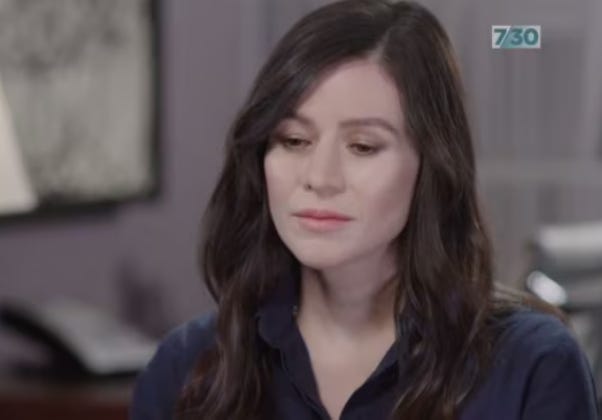
Silvey, however, is far more sinister than Rush. Because he claimed to be fighting precisely the abuse of which he owned and distributed digital images. (I do not recall Rush ever going on the record as combating sexual harassment for example.) Silvey’s hypocrisy is unconscionable. He played us all for fools, even the Indigenous/feminists. Maybe especially them.
Fortunately I was never that interested in reading novel number four, Honeybee, as I do not accept the premise of the “trans child” on which it is based. Definitively off the list now though. I might have read number five, Runt, because I like stories about little girls and dogs. Not now.
To return to the question: can we separate the author from the work? Sometimes, perhaps. If enough decades or centuries have passed, perhaps. But when abuse of women and children is concerned, and when the author claims to be on the side of the abused? Yep, I’d be taking Jasper Jones off school reading lists too.
She was strong and smart so she couldn’t have been a woman
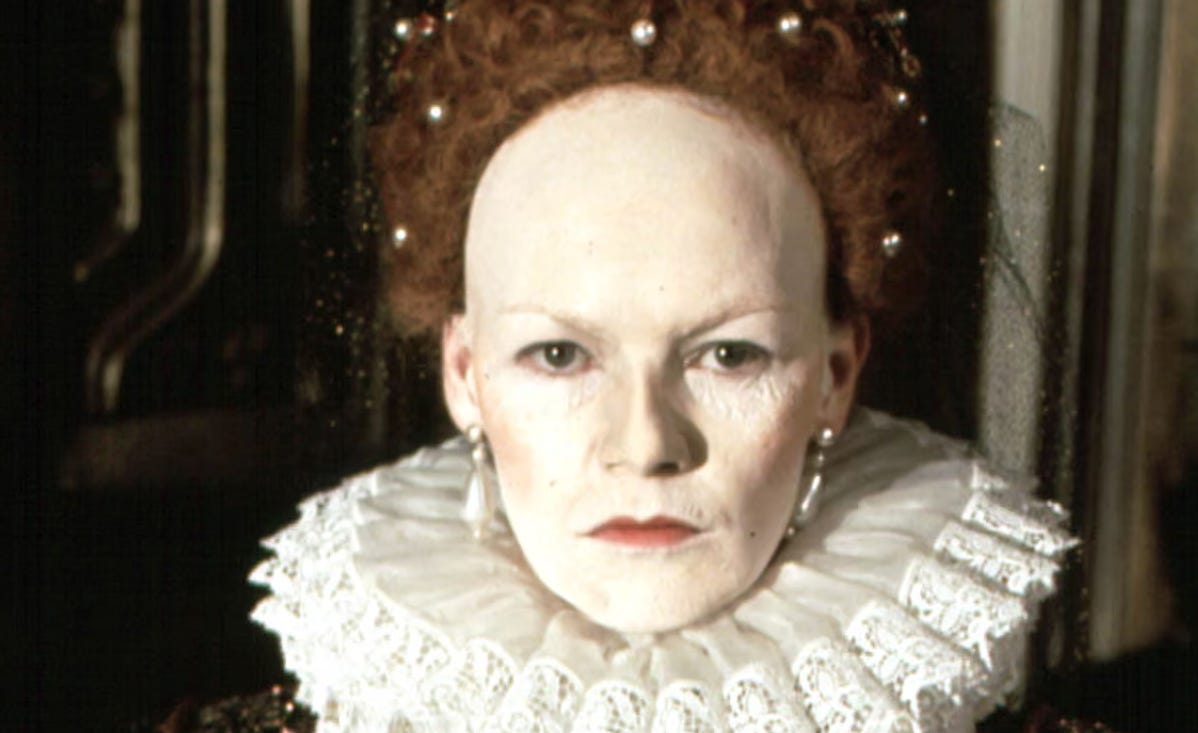
Now, shifting gears a little, but remaining in the world of supposedly artistic representation, I turn to the latest manifestation of the curious practice of retroactively transing legendary female leaders, such as Joan of Arc (transed in a 2022 play performed at Shakespeare’s Globe in London). The most recent iteration is an ITV historical fiction series on the young Elizabeth I, currently under development, the casting call for which reads thus:
Jill Trevellick Casting (Downtown Abbey, Mr Bates vs the Post Office), is searching for someone to play the fantastic leading role of a young trans woman [emphasis in original], in MAJESTY, a six-part series for ITV. MAJESTY is an emotionally and funny alternate history that takes place in the time of the Tudor court.
We are looking for someone who can play a character that is intelligent, compassionate, brave, likable, witty and charming. The smart bright child we meet at the start will grow up to be a strong young woman.
Appearance: White [so, not doing a Bridgerton, then, where the alternate history includes mixing it up race-wise].
[and then, in CAPITALS:] WE ARE PARTICULARLY KEEN TO RECEIVE SUBMISSIONS FROM ACTORS WHO IDENTIFY AS TRANSGENDER WOMEN FOR THIS ROLE.
According to the show’s creators William Harper, Joan Rater and Tony Phelan, “Majesty is an emotional, funny, and contemporary-feeling alternate history about how three outsiders try to stay alive while hiding a secret that, if discovered, would rock England to its foundations. Majesty allows us to have fun with history while illuminating who we are now. This show is pure wish-fulfilment of how people devoted to the public good suddenly find themselves in a position to make a difference.”
Thing is, if that “secret” had been discovered, Liz the First would
(a) not have damn well hidden it in the first place (a more plausible narrative would have been passing as a man, à la Pope Joan or—spoiler alert—the new Pope in the film Conclave), because Man=fully human and monarch material and Woman=the poor substitute you end up with when no Bloke is available so why in the name of all things Royal would you do that? (even in Bridgerton that would have been a stretch: Charlotte is only Queen because George Three is seriously nuts);
(b) consequently been a male heir so poor old Anne B may not have got the chop and there would have been no Queen Mary with her English version of the Inquisition; perhaps no Jane Seymour nor Teddy Six either;
(c) as a friend pointed out (thank you, Claire!), have taken a wife and produced offspring, thus ensuring an English line of succession and getting in the way of unification of English and Scottish thrones under one monarch (which is why Mary Queen of Scots got shortened and all, heading off Scottish claims at the pass); and thus
(d) the history of England and indeed the UK as a whole would have turned out very differently indeed. Who knows what would have happened with Oliver Cromwell in that case? Would Scotland have become another Ireland/Northern Ireland in the 20th Century with its own Troubles?
The idea of turning Liz One into a trans-identified male is so completely preposterous that it would not be worth our attention except… except that it is given weight by a whole TV network and a Who’s Who of TV drama creators. Except that we are being fed the line that a far more plausible narrative than Liz One being an actual woman who refused the usual trappings of woman-ness to become a legendary ruler is that she was a cross-dressing bloke. No, really? We are expected to swallow such tripe? Did I say Age of Absurdity? Did I say gaslighting? If one falls for this sort of rubbish, then one will easily fall for the line: “Did you know the word gullible has been removed from the dictionary?”
She was a woman so she needed rescuing by A Proper Bloke
Which brings me back to the tortuous and woman-effacing path that took us from Gaslight to “gaslighting”. In doing some digging on the theatrical and film sources, I came across this essay by Nora Gilbert, Professor of Literary and Film Studies at the University of North Texas. Writing on the accessible book review website Public Books, Gilbert points out that the focus of exchanges between the female protagonist and her murderer husband is not the dimming gaslight but the objects he has hidden or displaced and then accused her of “forgetting” she moved or stole. She never raises the gaslight with him, but rather with the detective, who “immediately and appreciatively … praises the ‘keenness’ of her observation, remarking that she ‘should have been a policeman’ herself. The detective understands, in other words, how crucial the wife’s skills of discernment are to solving the mystery and catching a murderer.”
The “gas light” of the title has, thus, been misleadingly misunderstood. Instead of serving as yet another example of scheming manipulation on the husband’s part, the dimming of the lights in fact represents a way out of the gaslighting abyss for the wife who—in spite of her husband’s efforts to blur and blight her sense of her surroundings—is sharp-witted and sharp-sighted enough to realize it’s happening.
Gilbert, to whose analysis I am indebted, thus suggests that the meaning we now give to the term “gaslighting” would have been more accurately conjured by “brooched” or “pocket-watched”, these being two of the objects that the husband has moved around to try to convince his wife that she is going insane. More importantly, she suggests that the agency of our heroine, already present in the successive scripts, is disappeared by the “gaslighting” narrative. We are, in short, being gaslit by “gaslighting”. Are you all following along there?
Moral of today’s story?
(1) Never trust anything some bloke tells you unless you have cross checked it from several sources (and listened to your own gut feeling about something being off about his narrative);
(2) Even when his narrative seems kosher, still don’t trust him. He could be Craig Silvey or Jeffrey Epstein or any one of a number of other blokes being suave and engaging.
(3) Never believe a bloke is a woman just because he tells you so. Ask yourself why the hell would he want you to play along with that?
(4) Learn some history.
The End.
What an enjoyable, provocative piece if writing. Very very clever, as usual.
Loved this 👏 I now realise I should see that film again.