
Being human, having rights
Still waiting…

It is quite the year for round-figure anniversaries (10th, 40th, 50th and so on…). I didn’t quite make my own deadline for covering some nationally-based November ones, in Australia (50th anniversary of the Dismissal), France (10th anniversary of the November, 2015 terrorist attacks) and Spain (50th anniversary of Franco’s death), which occurred within ten days of each other, but I may produce something before the year is out. Even if by then it will be last month’s news. Or possibly last year’s…
Today, however, on this Human Rights Day, I am looking at international and more specifically United Nations anniversaries. This year the UN turns 80, and the Beijing Declaration and Platform for Action emanating from the UN’s Fourth World Conference on Women turns 40. It is also the 50th anniversary of the UN’s International Women’s Year and its first World Conference on Women in Mexico City. (The second and third were held in 1980 in Copenhagen and 1985 in Nairobi. There were Beijing Plus Five and Beijing Plus Ten conferences at UN Headquarters in New York City in 2000 and 2005 respectively, and since then, the UN has not seen fit to organise another World Conference on Us. Perhaps just as well, because now it would also include some males who claim to be Us as well.)
The Universal Declaration of Human Rights (UDHR) was signed on 10 December 1948, which is why today is Human Rights Day. So human rights, in UN terms, are three years younger than the institution that framed them, being merely a spry 77 years old beside the UN’s own 80. (Women’s rights are also younger than the UN Year of Us: the Convention on the Elimination of all forms of Discrimination Against Women (CEDAW) was signed in 1979.
Human rights as we understand them today are a Western concept, and an Enlightenment one. Both the West and the Enlightenment get a bad rap these days, and there are certainly many things to criticise in both, but there are few if any progressives in the world today who would suggest that either inalienable individual rights or robust democracy are bad ideas and should be dispensed with. Even if nonwestern cultures have invariably had some notion of doing right by others or what a just society looks like, our contemporary understanding of human rights comes to us from Western documents, initially the English Magna Carta of 1215, notably its Clauses 39 and 40*, which would lead to the development of the notion of inherent and inalienable individual rights on both sides of the Atlantic during the latter half of the 18th century.
*39. No free man shall be seized, imprisoned, dispossessed, outlawed, exiled or ruined in any way, nor in any way proceeded against, except by the lawful judgement of his peers and the law of the land.
40. To no one will we sell, to no one will we deny or delay right or justice. (English translation: the original was penned in Latin)
Certainly, the US Bill of Rights and the French Declaration of same were elaborated by the rising bourgeois and mercantilist class with the aim of curtailing (or ending) the power of the Crown (and in France’s case, that of the Church as well), and at the time of its elaboration women were definitely not considered human, but it was nonetheless the first time in history that the very fact of being human was defined by the inalienability of rights.
“Are women human?”
“Are women human? It’s not an academic question”, wrote V. Spike Peterson and Laura Parisi in 1998, in an anthology to mark the 50th birthday of the Universal Declaration of Human Rights.[1] (Today we might ask: “Are women women?” Because now, for many institutional actors, even at UN level, “women” now means “women plus some men [those with a gender identity]”. Which renders the term meaningless because it could technically include every man on the planet as well, in the event that all men suddenly decided to adopt a “woman” gender identity. But let’s set that aside for the moment.)
In their book chapter Peterson and Parisi stated what for Us are self-evident truths: that “the masculinist state institutionalises and sustains” male domination (which they unfortunately call “gender hierarchy”), and that “masculinist cultural norms favour males”. Well, quite. They further point out that international human rights instruments reinforce masculinist logic, notably in their privileging of the family as “the natural and fundamental group unit of society” that is “entitled to protection by society and the State”. This clause appears centrally in all three of the core UN treaties: the UDHR, the International Covenant on Civil and Political Rights (ICCPR, 1966) and the International Covenant on Economic, Social and Cultural Rights (ICESCR, 1966). They also point to the heterosexism of human rights framings (which many of us, from Monique Wittig on, would argue are a fundamental component of masculinism anyway).
Since Olympe de Gouges published her Declaration of the Rights of Woman in 1791 as a feminist response to the French revolutionaries’ Declaration of the Rights of Man (1789), feminists have known that this Rights caper was a male preserve. The response has not, however, been to simply say “let’s ditch the whole thing and do something different”. Rather, it has been to highlight what it is that deprives us of rights in the first place and attempt to improve on the model—for a start, by including women as people. Gouges, for her part, famously wrote that if women can equally with men be sent to the scaffold then they must be able, equally with men, to take to the podium. Her Declaration also outlined women’s right to divorce and to financial independence. Even better: in the Preamble, the first part of which appears below, she wrote that “the ignorance, neglect or contempt of women’s rights are the sole causes of public misfortunes or the corruption of governments”. Heady stuff.
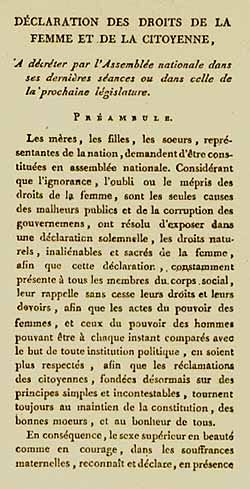
Gouges’ Declaration was calqued on the Declaration of the Rights of Man, seeking to improve upon it, with both a Preamble and a Postamble that are well worth the read, and she appended a model marriage contract as well: it would take almost another 200 years for a similar instrument to be enacted into law. Obtaining the vote took almost as long.
CEDAW is another document that attempts to fix the exclusion of women from the Rights of Man. Its Article 1 defines Discrimination Against Women as follows:
Any distinction, exclusion or restriction made on the basis of sex which has the effect or purpose of impairing or nullifying the recognition, enjoyment or exercise by women, irrespective of their marital status, on a basis of equality of men and women, of human rights and fundamental freedoms in the political, economic, social, cultural, civil or any other field (emphasis added).
The rest of the Declaration sets out what States Parties must do to fix this. The world’s women are of course still waiting. (Of course, a lot of the world’s people of both sexes are still waiting for their rights as articulated in the three core UN treaties to be enacted as well. Which is the main thing that’s wrong with rights in the UN system. Not only do the treaties fail to clearly articulate what it is that deprives people of rights in the first place, but states rarely if ever suffer any penalty for failing to protect the rights of their citizens.)
Others have tried to develop new models altogether, even as they draw on liberal notions of those fundamental rights and freedoms that define what it is to be human. Martha Nussbaum’s Capabilities approach is one such model. This approach focused on “what people are actually able to do and be” and the tools and conditions required for those capabilities to be realised, “treating each [person] as an end and none as a mere tool of the ends of others”.[2] Her ten capabilities encompass both negative rights and freedoms (as in, absence of prohibitions or oppressions, or freedom from) and positive rights and freedoms (as in, the right or freedom to something, which implies a positive duty on states). They are: life; bodily health; bodily integrity; senses, imagination and thought; emotions; practical reason; affiliation; relationships with other species; play; and control over one’s environment in both political and material senses.
There again, women are still waiting.
“Critical areas of concern”
A few years before Nussbaum published her model, the Beijing World Conference on Women happened, and the Beijing Platform for Action (BPFA) remains, along with CEDAW, the UN document of reference for its approach to women’s rights. The Platform lists twelve “critical areas of concern” for women’s rights: poverty; education; health; violence; armed conflict; the economy; power and decision-making; institutional mechanisms; human rights; media; the environment; and the girl child.
(Lesbian rights almost made it into the Platform. The Australian government delegation, led by Carmen Lawrence, supported its inclusion. But other governments were of course opposed and we were written out. How much more vital would our inclusion be today, with lesbians being tortured and persecuted in many countries, or transed in others, and everywhere deprived of gathering spaces.)
All of the Beijing critical areas remain critical areas. They have the virtue of covering pretty much every aspect of women’s lives, and the BPFA is a damn good document (all 178 pages and 361 paragraphs of it). Yet, women are still waiting. And waiting.
If only as much energy was put into addressing all these critical areas for women’s rights as is put into meeting, talking and writing about them. But then, that would need states to have the political will to do so.
Speaking of… two years ago the Australian Labor government launched a review of its Human Rights Framework. As the 2023 Labor Party Platform puts it:
Noting that Australia is the only democratic country in the world that does not have some form of comprehensive, national human rights legislation, a federal Labor government will consider whether our commitment to the implementation of human rights standards could be enhanced through a statutory Charter of Human Rights and Responsibilities, or similar instrument.
In 2024, the Joint Parliamentary Committee handed in its 486-page report, recommending among other things that the Australian government indeed adopt a Human Rights Act. The Federal government has to date completely ignored that report, even though it was supposed to respond to it within three months and even though was re-elected earlier this year with a landslide majority and thus a clear mandate from the Australian people to, oh, you know, Do Things.
Still waiting. On this our Day of Days.
[1] Evans, Tony (ed.). 1998. Human Rights Fifty Years On: A reappraisal. Manchester & New York: Manchester University Press.
[2] Nussbaum, Martha. 2000. Women and Human Development: The Capabilities Approach. Cambridge & New York: Cambridge University Press, p. 5.
It became obvious to me several years ago that that entire trans rights juggernaut is no more than a men's rights movement in drag. I don't care how beauteous your tresses are, how big your boobs are or how much shapelier your calves are; if you were born with a penis, you will never be any sort of woman at all and the fact that these fellas in frocks insist on inserting their presence is all the proof that anyone should need that they are indeed males exerting their privilege.
I feel an immense sorrow for those legions of girls who are so desperate to escape the male gaze of hypersexuality that we all have to deal with every day of our lives, that they resort to self-mutilation, aided and abetted by adults who should know better. For those who manage to retain their fertility and go on to discover the amazing power of the female body, their grief at what they have lost will be with them forever. https://lucyleader.substack.com/p/there-was-no-neuroscience-to-change
I love the way you write of Us. Many cheers for Olympe de Gouges, whose boldness (she was passionately anti-slavery too) was rewarded with the guillotine.